Industrial Hand Winches vs Marine and Recreational Winches: What Actually Separates Them?
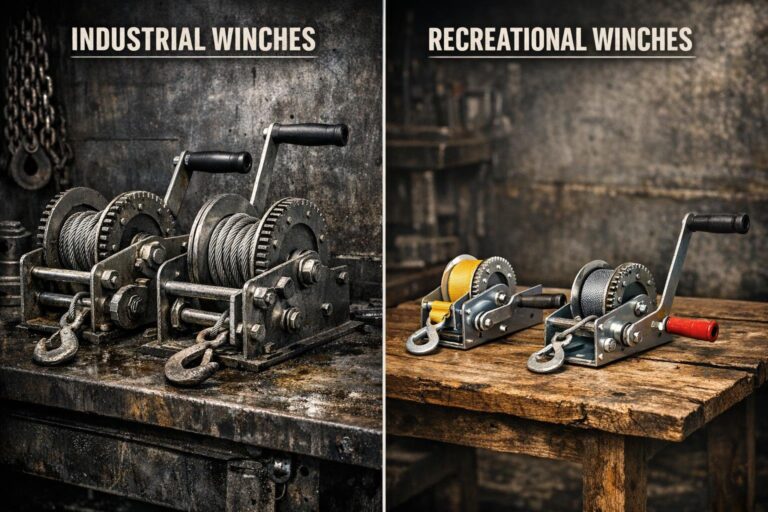
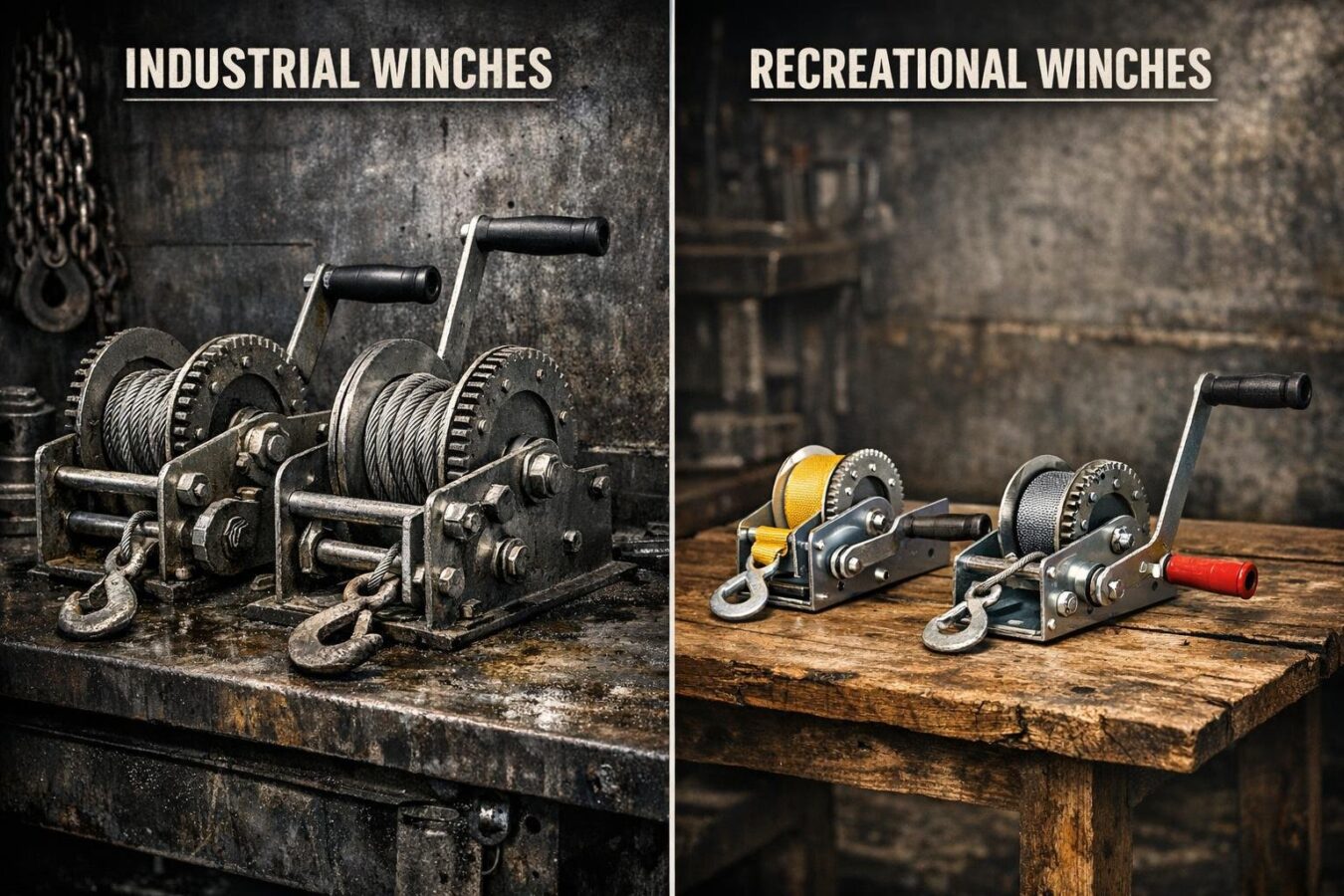
Not every hand winch belongs in the same conversation. A light-duty trailer winch built for occasional boat loading is not the same thing as a true industrial hand winch built for controlled pulling or lifting, defined working loads, and demanding environments.
Search for a hand winch online and you run into the same problem over and over. Recreational trailer winches, marine winches, utility crank winches, and industrial hand winches all get grouped together as if they are just different versions of the same tool.
They are not.
That confusion is exactly why buyers end up comparing the wrong equipment. A hand winch used to pull a small boat onto a trailer is solving a very different problem than a hand winch used in manufacturing, plant maintenance, utilities, equipment handling, infrastructure, or other industrial applications.
That is why Bear Equipment’s hand winch range makes more sense beside industrial manufacturers like Gebuwin, Thern, and Wintech than beside generic trailer-store winches. They are part of the industrial hand winch category, even if each manufacturer structures its range a little differently.
The biggest mistake people make with hand winches
The easiest way to get winches wrong is to assume they all serve the same purpose.
A recreational or marine trailer winch is usually selected for a narrow job. Pull a boat onto a trailer. Move a light load. Handle occasional use. Price matters, convenience matters, and the use case is fairly limited.
An industrial hand winch is chosen differently. Now the focus moves to working load limit, mounting style, controlled lifting or pulling, brake behaviour, gear type, corrosion resistance, rope storage, and how the winch fits the exact application.
That difference shows up clearly in the way Bear Equipment presents its hand winches. The range is not built around vague marketing claims or casual “pulling power.” It is organized around industrial variables like WLL, drive type, brake type, handle type, mounting style, and material or finish options.
That is industrial equipment logic, not consumer accessory logic.
Industrial buyers start with WLL, not guesswork
One of the clearest differences between industrial hand winches and everyday recreational models is how capacity is communicated.
In the industrial category, the serious starting point is working load limit. Bear Equipment’s hand winch page makes that explicit, with models ranging from 175 lb up to 11,000 lb WLL depending on series.
That matters because industrial selection is not just about the number printed beside “capacity.” It is about matching the winch to the real job. Load, startup force, angle, drag, duty, cable storage, and mounting geometry all affect selection. That is a completely different mindset from the casual “it should probably handle it” approach that often drives low-end consumer purchases.
You see the same disciplined approach from other industrial manufacturers. Thern separates its hand winch lines by gear type and load range, while Wintech does the same with worm gear and spur gear families across a broad industrial range. Gebuwin also frames its manual winching products within defined industrial applications rather than generic consumer use.
That is the real distinction. Industrial winches are selected, not just bought.
Pulling and lifting are not the same thing
Another reason the online winch conversation gets muddy is that people often treat pulling and lifting as if they are interchangeable.
They are not.
Industrial manufacturers are usually much more precise about that. Bear Equipment specifically identifies which hand winch series are intended for pulling, which are intended for lifting, and which are suited to both. That alone tells you Bear is operating in a more serious product category than the average trailer winch seller.
Once lifting enters the discussion, brake design, mounting style, cable exit, operator control, and overall application fit become much more critical. A winch selected for controlled lifting is not just a crank tool with a bigger sticker on it.
That is one of the biggest reasons industrial hand winches deserve their own category. The application itself demands more from the equipment.
Gear type is not brochure filler
Consumer buyers often overlook gear type completely. Industrial buyers usually cannot afford to.
Bear’s hand winch range includes worm, spur, direct, and chain-driven configurations depending on the series. That is not random variety. It reflects different operating characteristics, different use cases, and different load-handling expectations.
Thern separates its hand winch lines into spur gear and worm gear families. Wintech does the same and explicitly describes its worm gear hand winches as automatic self-locking. That is exactly the kind of language you expect from industrial equipment because gear type is tied directly to control, holding behaviour, and application suitability.
This is the kind of detail that immediately separates industrial hand winches from everyday marine and recreational models. In the industrial category, gear choice is part of the actual engineering conversation.
Brake design is one of the clearest industrial markers
If you want one simple way to explain the difference between industrial hand winches and lighter recreational units, look at how the brake system is discussed.
Bear Equipment lists braking method across its hand winch series, including load pressure brake with ratchet, spring-applied brake, and self-locking worm-related behaviour in the GW line. That is not decorative spec-sheet filler. That is a sign that the equipment is designed around controlled load handling.
Gebuwin uses the same kind of industrial language, describing hand winches with load pressure brakes and worm or spur transmission. Wintech’s worm gear models are described as self-locking. Thern also frames its hand winches within a broader professional lifting and positioning context.
This is where the category confusion online really falls apart. A lot of generic “best hand winch” content treats the winch like a simple crank tool. Industrial manufacturers clearly do not. They are designing around how the load is controlled when the operator stops, changes direction, or uses the winch in a fixed-duty application.
Industrial hand winches are selected for environment too
Another major difference is environmental fit.
A lot of low-end winch content treats outdoor use as if it is one generic condition. Industrial manufacturers do not. Environment matters.
Bear Equipment offers different material and finish paths across its hand winch range, including painted steel, galvanized steel, stainless options, and aluminum depending on the series. Bear also points to specific lines when corrosion resistance matters more.
That same industrial thinking is obvious with Gebuwin, which positions its products across sectors like maritime, offshore, water, petrochemical, defence, and theatre. Thern does something similar by tying its products into industries like water and wastewater, manufacturing, construction, mining, and energy.
That matters because a hand winch living in a clean indoor facility is one thing. A hand winch exposed to moisture, salt air, washdown conditions, or corrosive environments is another. Industrial manufacturers build around that reality.
Mounting is not an afterthought in industrial applications
Mounting style is another point where true industrial hand winches separate themselves from generic light-duty units.
A lot of consumer winch content treats mounting as little more than “bolt it somewhere solid.” Industrial winches do not work that way.
Bear lists wall-mounted, console-mounted, and wall or console configurations depending on series, and it connects those mounting choices directly to rope exit and application fit. That is exactly how industrial equipment should be discussed, because the winch is often part of a larger fixed system rather than a casual accessory.
Wintech also highlights mounting flexibility on certain hand winch lines. Again, this is not a cosmetic detail. It is part of application engineering.
Where Bear Equipment fits in this category
Bear belongs in the industrial hand winch category. Full stop.
That is obvious from the way Bear structures its hand winch lineup. The product range is built around manual pulling and lifting applications, multiple industrial series, WLL-driven selection, different drive systems, brake types, handle styles, mounting options, and material or finish choices.
That also puts Bear naturally in the same broader category conversation as Gebuwin, Thern, and Wintech. Not because all four manufacturers are identical, but because they are speaking the same industrial language.
They are not selling “a hand winch” in the loose retail sense. They are offering application-specific manual winching equipment.
Gebuwin leans heavily into broad industrial sectors and product options. Thern presents hand winches as part of a bigger lifting and positioning ecosystem. Wintech shows strong industrial and marine-duty coverage across major capacity classes. Bear’s strength is that it lays out a practical, application-driven industrial hand winch range in a clear and usable way.
The real takeaway
A marine or recreational hand winch can be perfectly fine for light, occasional, narrow-use tasks.
But once the application involves defined working load limits, controlled lifting or pulling, brake behaviour, fixed installation, corrosion resistance, or higher industrial duty, the conversation changes. At that point, you are no longer comparing the same class of equipment.
That is where industrial hand winches begin.
And that is why it makes more sense to compare Bear Equipment with manufacturers like Gebuwin, Thern, and Wintech than to lump Bear in with everyday trailer winches and recreational crank hardware.
Once that distinction is clear, the category gets a lot less confusing. And usually, so does the buying decision.